In the Inland Empire we don’t really have “shoulder seasons” anymore. It’s cool, and then one week in late May the thermometer hits 98°F, and every AC unit in Riverside and San Bernardino County gets slammed. The systems that break down first are almost always the ones that didn’t get a pre-summer tune-up.
Here’s the exact AC maintenance checklist we run before the 100°F days hit — half of it you can do yourself, half of it you shouldn’t.
Why Pre-Summer Maintenance Matters More in the Inland Empire
A furnace in Southern California runs a few hundred hours a year. An AC runs 1,500–2,500 hours during Inland Empire summers. That’s equivalent to a car driven 60,000 miles a year. Any weakness in the system — dirty coils, low charge, weak capacitor — turns from a small inefficiency into a full breakdown once you start demanding continuous cooling in 105°F ambient temperatures.
ENERGY STAR’s maintenance guidance matches what we see in the field: a properly-maintained AC uses 5–15% less energy than a neglected one and lasts 3–5 years longer.
The DIY Part of the Checklist (30 Minutes)
1. Replace the air filter
This is #1 for a reason. A clogged filter restricts airflow across the evaporator coil, drops cooling capacity, and can freeze the coil solid. Check the filter today. If it looks grey or you can’t see light through it, replace it. During peak summer, change 1” filters every 30–60 days.
2. Clear the area around the outdoor condenser
The condenser (the outdoor metal box with the fan on top) needs at least 2 feet of clearance on all sides and 5 feet above it to breathe properly. Cut back shrubs, pull weeds, and remove anything stored against it. Airflow is everything for a condenser.
3. Gently rinse the condenser fins
Shut off power to the unit at the disconnect first. Then use a garden hose (not a pressure washer) to rinse the fins from the inside out where possible. Cottonwood fluff, dust, and lawn clippings collect on the fins and drop capacity fast. Do NOT use a pressure washer — you’ll bend the fins.
4. Check the condensate drain line
Find the small PVC pipe coming off your indoor air handler (usually terminates outside near the condenser or in a floor drain). A clog here causes water to back up, trip the safety float, and shut the AC off. A wet/dry vac on the outdoor end for 30 seconds usually clears it.
5. Test the thermostat
Switch to cool, drop setpoint 5°F below room temp, and confirm the system starts up and blows cold air within a couple minutes. If nothing happens, replace the batteries first. Then check the panel for a tripped breaker.
6. Inspect the disconnect and outdoor wiring
Look at the electrical disconnect box next to the condenser. Any burn marks, corrosion, or rodent damage is a call-a-pro situation. Do not touch. Rodents chewing wiring is a top cause of AC no-cool calls in the Inland Empire, especially after mild winters.
The Professional Part (Do NOT DIY)
7. Refrigerant charge verification
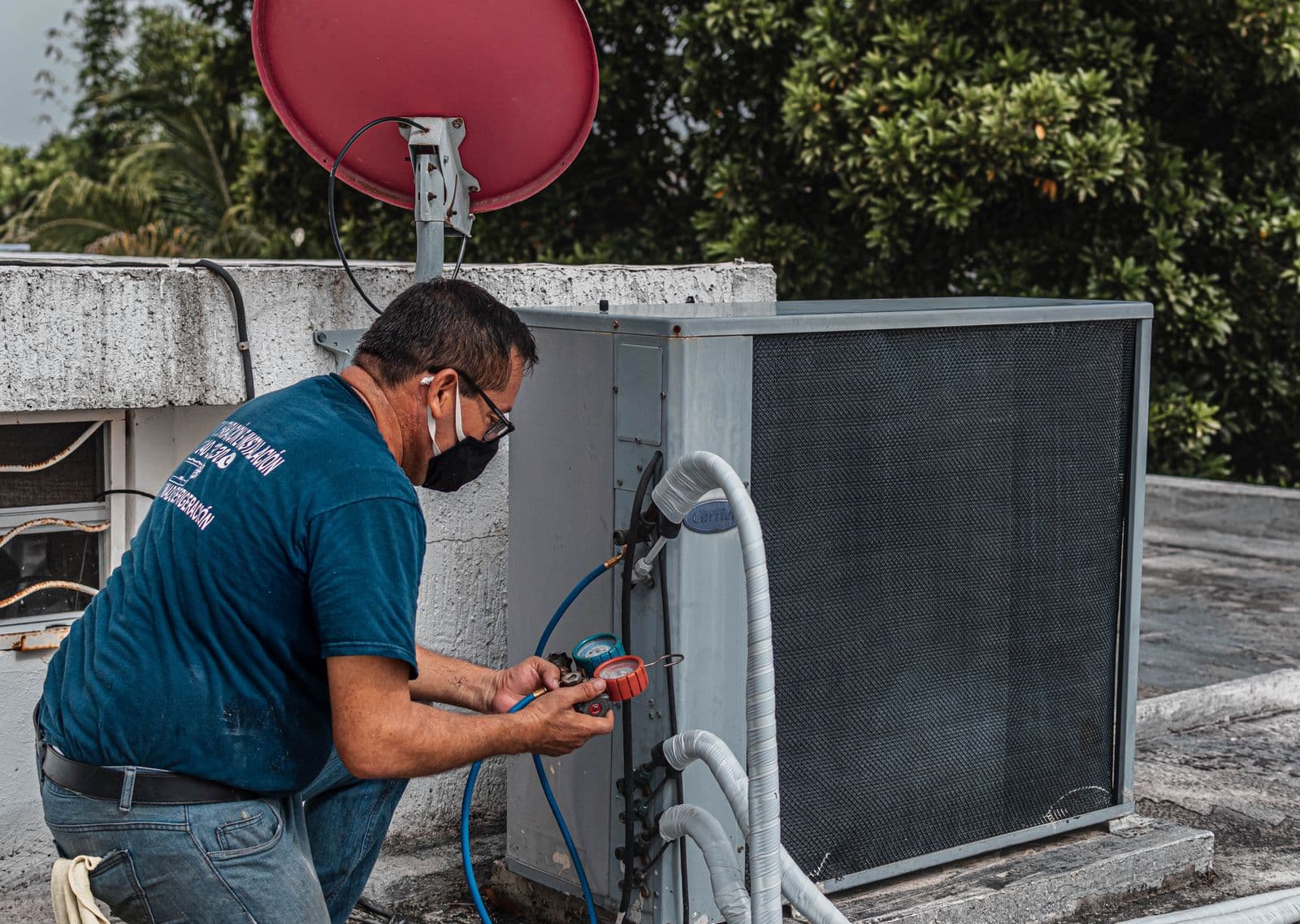
A licensed HVAC tech puts gauges on the system, verifies subcooling and superheat, and confirms the system has the correct refrigerant charge. Overcharge or undercharge both cost efficiency and can damage the compressor. Under EPA rules only Section 608 certified technicians can handle refrigerant. If any tech offers to “top off” refrigerant without finding the leak, walk away.
8. Capacitor test
The run capacitor is the single most common AC failure part in the Inland Empire — extreme summer heat degrades them fast. A tech tests capacitance with a meter and replaces any that are more than 10% out of spec. Replacing a weak capacitor before it fails is far cheaper than an emergency call the day it does.
9. Contactor and electrical connections
Pitted contactors, loose lugs, and burned wiring cause hard starts, tripped breakers, and eventually compressor damage. Every proper tune-up includes a full electrical check with amp draw comparisons against rated values.
10. Coil cleaning
Both the outdoor condenser coil and the indoor evaporator coil need proper chemical cleaning to remove years of accumulated dust and biological growth. A dirty evaporator coil can reduce cooling capacity by 15–20% by itself.
11. Blower motor and belt inspection
Amp draw check, bearing inspection, and belt tension (on older systems). ECM blowers are more reliable than older PSC motors but still need periodic checking.
12. Static pressure and airflow check
A pro measures duct static pressure at the air handler. High static means restricted ducts — often dirty coils, undersized filters, or crushed flex duct. Airflow issues also relate to duct condition; if your ducts have never been cleaned or sealed, a professional duct service is often the missing piece.
Warning Signs Your AC Won’t Make It Through Summer
- Longer run times to reach setpoint compared to last year.
- Ice on the refrigerant line or evaporator.
- Water pooling around the indoor air handler.
- System short-cycling (starts, runs 2–3 minutes, shuts off, repeats).
- Loud humming, grinding, or squealing.
- Electric bills 20%+ higher than the same month last year with no lifestyle change.
Any of the above and it’s time to schedule an AC repair diagnostic before the system fails in the middle of a heat wave.
Is It Worth Replacing Instead of Repairing?
If your AC is 12+ years old, uses R-22 refrigerant, or has needed multiple repairs in the last 24 months, running the numbers on a full replacement is worth doing. Modern variable-speed systems are 40–60% more efficient than what they replace, and Southern California rebates continue to be generous. We’ll always give you both options with real numbers on operating cost — never a scare-tactic upsell.
The Maintenance Plan Math
Most of our clients skip the “call every spring” game and just enroll in an annual maintenance plan. Two scheduled visits (spring AC, fall furnace), priority scheduling during heat waves, discounted repairs. Homes on a plan almost never call us on the hottest day of the year — that’s the whole point.
Slots book out fast once temperatures spike. Call (800) 697-4014 or book online. Serving Riverside, Corona, Moreno Valley, San Bernardino, Redlands, Temecula, Rancho Cucamonga, and the entire Inland Empire.